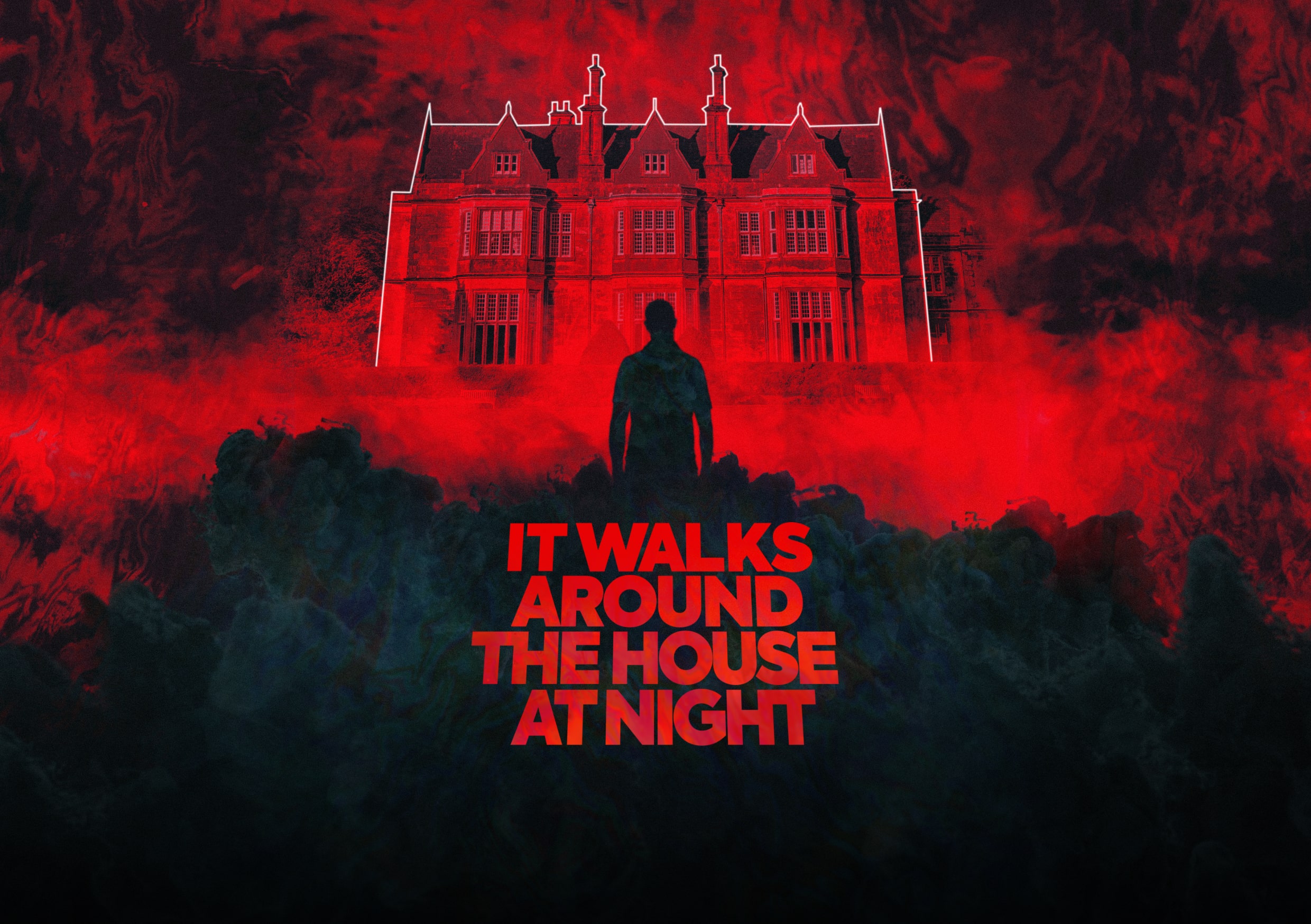
There is something devilishly pleasing about a play that asks its audience to be frightened by a man pretending to be a ghost only to learn, slowly, that he may not be the only spectre walking the boards that evening. Tim Foley’s It Walks Around The House At Night, the latest from ThickSkin at Southwark Playhouse Borough and running until 28th March 2026, starts from this deliciously unpredictable premise and runs with it into the dark.
Joe, a struggling actor, takes a cynical job: haunt a remote country manor for a mysterious gentleman who wants the performance of a haunting for his young relatives – and seems to have potentially romantic designs on Joe (or so Joe imagines). George Naylor plays him with a thirsty, weary charisma that earns your trust early. His narration drives the piece, and he handles the tonal shifts between deadpan comedy, gothic storytelling, and escalating dread with considerable ability. Equally memorable is Oliver Baines as The Dancer, a figure of fluid, unsettling physicality who seems to operate by different rules to everyone else on stage (which is, of course, precisely the point).

Director Neil Bettles clearly knows how to use a room. The design work from Pete Malkin and Joshua Pharo (sound, lighting, and projection operating in close concert) produces sequences of true chill: a repeated nocturnal walk that prickles the neckline, and a sleepwalking scene that disturbs with clever stage mechanics. When the production trusts its atmosphere and withholds, it is softly overwhelming.
The trouble is that it does not always have faith in this ambiance. Repeated appearances of cloaked figures, effective the first time, lose their menace through overemployment, a reminder that the imagination, once given a footing, does the work better than any performance. The writing, too, tends to over-explain, crowding the final act with exposition and narrative strands that dilute the very isolation the play has worked hard to maintain. The fear and the humour are not always well-calibrated either, with the anecdotal, storytelling mode engaging on its own terms, often with a marked politicism that seems overdone. This style can puncture tension at the wrong instant.

Foley’s language, at its best, is richly literary and seems indebted to the tradition of EF Benson and Arthur Machen, and alert to the class dynamics that underpin the ghost story as a form. That the play reaches for something more than a fright-night is to its credit. It just occasionally reaches so hard that it loosens its grip on the thing it already has.
Still, It Walks Around The House At Night is more often unsettling than not…and unsettling, in a theatre, is harder to achieve than it appears. ThickSkin have built something genuinely atmospheric and eerie here.