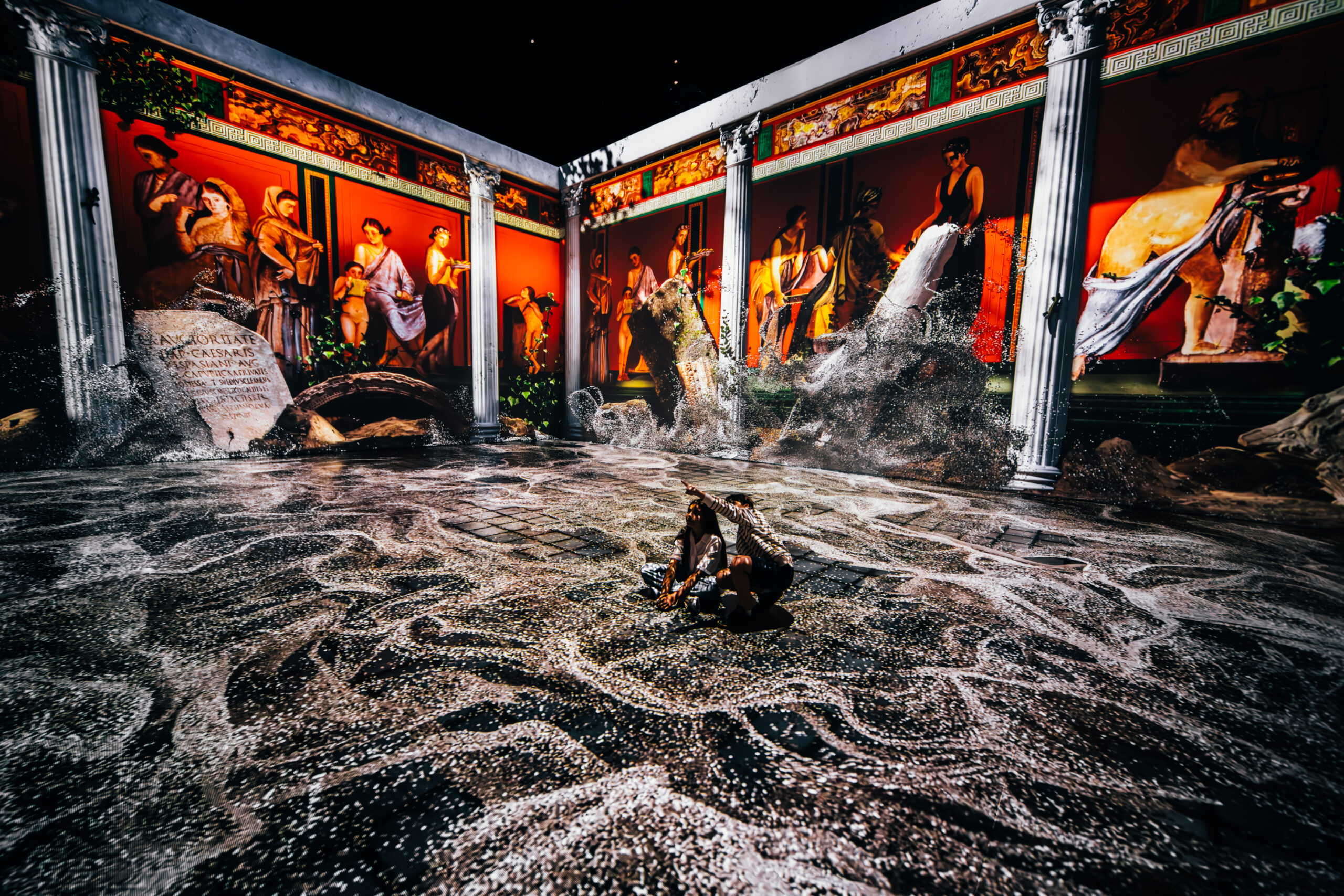
There are moments in archaeology when the past does not sit behind glass but rises about you, bright, living, and (especially when it speaks of disaster) troubling. The Last Days of Pompeii: The Immersive Exhibition at Immerse LDN (until 15th March, 2026) understands this. It’s an informative, engulfingly advanced, multisensory spectacle that is as ambitious as it is enjoyable. And for those who love history and the ancient world, it’s a must see.
The experience starts by grounding you in the human story. Before the ash and blaze of Vesuvius, there was a metropolis. Through objects and staged surroundings, Pompeii emerges as a lived-in place. Rather than ruin, it’s urbane, fashionable, and indulgent. A trickling fountain spills into the air, and columns stand tall around seating areas beckoning you to take your ease. You are reminded that this was a thriving Roman settlement with its own regularities and rites, complete with marketplaces and the everyday objects purchased within. The educational framing is accessible without feeling patronising, and the description of rediscovery, including the melancholy legacy of Fiorelli’s body casts, adds necessary emotional heaviness.

Then the exhibition pivots into immersion. The 360-degree projection room is the first true bombshell. Immeasurable and all-encompassing, it moves from the bustle of daily existence to the intensifying dread of Vesuvius with cinematic self-confidence. Excellent use of projection mapping traces mosaics upon the walls and floor, reconstructing villas, and the city itself, as well as the words of Pompeiians within. A nice touch are the innumerable fish and lizards, swimming and crawling, respectively, right by your feet. When the eruption approaches, gentle it is not. It is deafening, remarkable, and scored with swelling instrumentation that leans into theatre. Some may find it a touch grandiloquent; others will find it awe-inspiring. Either way, it is successful. The sound design often holds the space, turning geological devastation into something visceral.

Virtual reality adds another stratum of theatricality. The gladiatorial stadium sequence, complete with chariots and boisterous crowds, feels blockbuster in tenor. It is exciting, if not understated. For traditionalists seeking hushed respect, this may feel like Pompeii via disaster film. For families, younger spectators, and history fans, it is engaging. Moreover, it is indicative of a certain haughtiness amongst academics that they would not embrace such new technologies in the explication of their subject – for what better way to increase knowledge of the ancient world than plunge one into it?
The true highpoint, though, is the free-roaming Metaverse reconstruction of the Villa of the Mysteries. Here, the sights soften and one becomes an explorer of the past. You move through rebuilt interiors, wine vaults, walkways with exquisite paintings, and the bathhouse, engaging with the constructions rather than witnessing them. It is here that the technology feels most focused and greatest aligned with one of archaeology’s central goals: reconstruction. Buildings are a part of this, but more important are the lives of those living within them. To step into those lives allows one to see their world a little more as they did.

The interactive digital sandpits and charting tables reel us towards a spirit of playful knowledge. Children become archaeologists for the day, discovering hidden layers and patching together remains. It is tangible in a digital sense, a real bridge between teaching and entertainment. A writable graffiti wall, evocative of Pompeii’s own graffiti, was a brilliant piece of exhibition design. Finally, why not see yourself as a Roman via the AI photo booths? This reviewer came out looking more chiseled! Both these aspects reinforce the exhibition’s understanding that history resonates best when people can see themselves reflected in it.

Some criticisms are founded. The production sometimes prioritises spectacle over strict history, and certain dramatic embellishments can at times feel excessive. A few more original artefacts would have added seriousness. There are moments when the soundtrack swells a fraction too much. But let us be clear: these are tweaks, not fatal faults.
At about ninety minutes, the experience is well-paced, moving from traditional exhibition space into complete immersion. It feels designed for breadth rather than academic complexity, and that is its forte in that it opens the door. For many guests, especially those less inclined towards conventional galleries, this may be the most immediate and resonant meeting with Pompeii they have experienced.

This is archaeology reimagined for the digital age. Not delicate, not controlled, but brave and comprehensible. It may thunder where others murmur, but in doing so it captures something essential about Pompeii itself, a city as much a place of theatre as of tragic disaster, balanced precariously between magnificence and pumice.


Leave a Reply